Action-Token Supervision and Gradient Routing in Mixture-of-Transformer VLAs
TL;DRWhether to insulate the VLM depends on action-token supervision and the evaluation setting.
We study this choice in autonomous driving and manipulation by independently varying action-token supervision and expert-to-VLM gradient flow. In open-loop driving, action-token supervision can partly substitute for expert gradients: insulation is competitive with coupling when action tokens are supervised, but increases prediction error by roughly 25% without them. Under concurrent training, coupling improves closed-loop driving performance regardless of action-token supervision, with a similar pattern in manipulation. These results challenge insulation as a default VLA training recipe.
Paper link, authors, and citation will be added with the arXiv release.
Should the continuous-action loss train only the expert, or also the VLM that produces its conditioning K/V cache?Figure 1
We independently vary whether action tokens are supervised and whether the expert’s gradient updates the VLM.
01 Action supervision and gradient routing
Action-token supervision shapes the effect of expert-to-VLM gradient flow.
The VLM processes visual observations and language instructions, while the expert generates continuous action chunks conditioned on the VLM’s per-layer key–value representations. We vary future-action-token supervision and expert-to-VLM gradient flow independently.
01
Action-token supervisionFuture-trajectory tokens / FAST action postfix
02
Gradient routingDoes the flow loss update the VLM?
The action-token CE and expert flow loss both update the VLM.
Action supervision and expert gradient flow
VLM predicts future-action tokens<act7><act9>…Trajectory tokens (driving) · FAST postfix (manipulation)Action-token CE updates VLM ↓
Continuous actionsFlow loss ∇Lflow ↓
Visual observation“What should the vehicle do next?”
→
VLM
→layerwise K/V
Action expert
×stop-gradient
Flow loss gradient reaches the VLM
The VLM is supervised to predict future-action tokens during training. They are not decoded at evaluation.
VQA, reasoning, and structural-token supervision remain active in every condition. Stop-gradient changes only the backward pass through the K/V interface.
02 Experimental design
Action-token supervision, gradient routing, and training schedules.
We compare three schedules for the same four conditions. Concurrent training starts the VLM and expert together. VLM-first trains the VLM alone for 100k steps before adding the expert; expert-first trains the expert against a frozen VLM for 100k steps before updating the VLM.
All four conditions are evaluated under concurrent, VLM-first, and expert-first training.
01
Same future trajectory
The discrete action tokens and continuous expert encode the same future trajectory.
02
Gradient routing
Insulation stops the expert’s gradient before it enters the VLM. The forward computation is unchanged.
03
Training schedules
Concurrent training starts both modules together. VLM-first and expert-first training start one module after 100k steps of training the other.
03 Results
The value of insulation depends on action supervision and evaluation setting.
In open-loop driving, insulation is competitive with coupling when action tokens are supervised. Under concurrent training, coupling improves closed-loop performance regardless of supervision.
01 / Open-loop driving ADE ↓
The effect of gradient routing depends on action-token supervision.
With action-token supervision, insulation slightly lowers ADE on the Public Golden split, while the OOD routing difference is comparatively small. Without action-token supervision, the insulated model has substantially higher ADE in both evaluations. Relative to insulation, coupling reduces ADE by approximately 26% on Public Golden and 24% on OOD.
First-sample mean ADE at 300k total steps. Bootstrap intervals capture variation across evaluation clips for fixed checkpoints.
First-sample mean ADE across training histories; lower is better.
02 / Closed-loop driving Route progress ↑
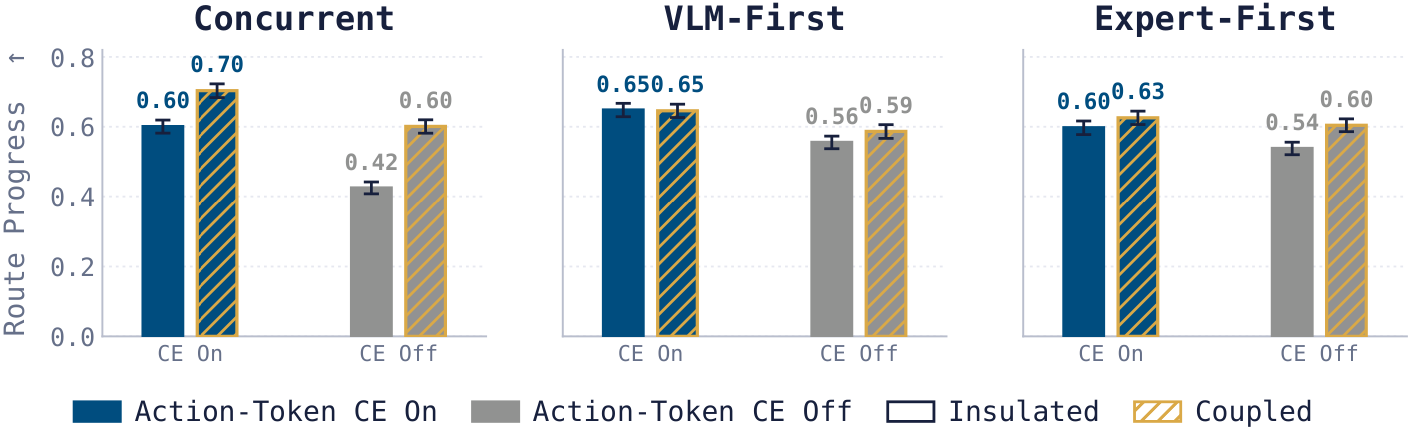
Coupling improves route progress with and without action-token supervision.
In concurrent training, coupling raises AlpaSim route progress from 0.600 to 0.703 with action-token supervision and from 0.425 to 0.601 without it. The latter is a 17.6 percentage-point increase on the same evaluation scenes.
Five stochastic rollouts per scene are averaged within each scene. Progress is normalized from 0 to 1.
See closed-loop progress across training histories ↗AlpaSim route progress across the three driving training histories.
03 / Robot manipulation Task progress ↑
Coupling improves observed closed-loop manipulation progress with and without FAST supervision.
The observed gain is larger without FAST: mean progress rises from 10.3% to 32.9%, compared with 19.5% to 30.7% with FAST.
Equal-weight mean over BlockStackKitchen, FoodBussing, and PanClean at 400k training steps.
Mean task progress · three PolaRiS tasksπ₀.₅
FAST on · Insulated
19.5%
FAST on · Coupled
30.7%
FAST off · Insulated
10.3%
FAST off · Coupled
32.9%
Published π₀.₅ reference: 40.0% (CoVeR’s evaluation protocol).
04 Qualitative examples
Selected closed-loop rollouts.
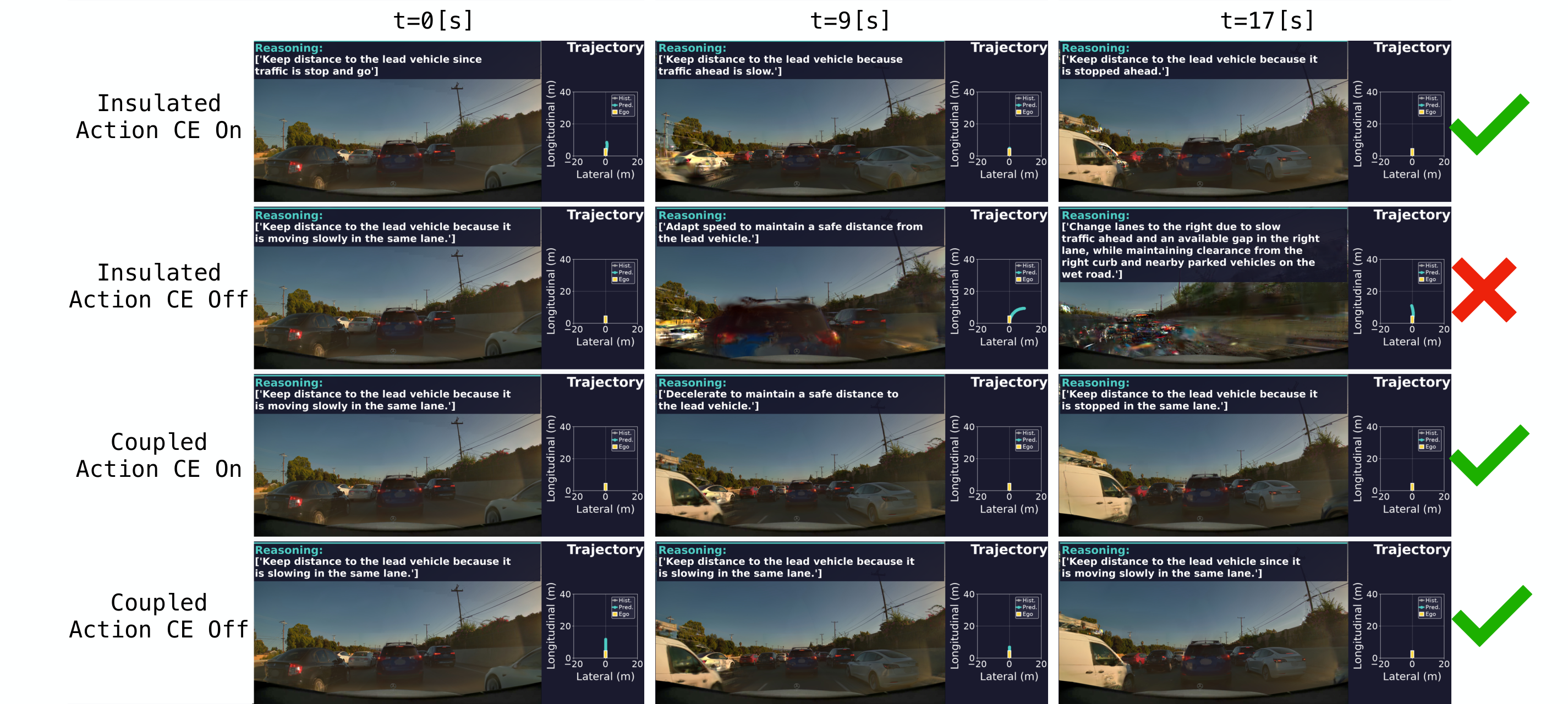
These examples show individual rollouts. The results above report aggregate evaluations.
A / Driving
Three scenes, four training conditions
Each scene shows concurrent-training AlpaSim rollouts at 300k steps for the four action-token and gradient-routing conditions. Select a scene to compare the model reasoning and predicted trajectory.
Concurrent training · 300k steps · 20 s
Insulated · tokens on
Insulated · tokens off
Coupled · tokens on
Coupled · tokens off
0:00 / 0:20
See the manuscript’s driving qualitative figure ↗Selected closed-loop driving cases.
B / MolmoAct2 manipulation
Three paired tasks
Four concurrent-training conditions from the same initial state and instruction in each task. The progress score updates when the PolaRiS evaluator records a new milestone.
Concurrent training · 300k steps · PolaRiS adaptation 1k · 15 s
Use the yellow sponge to scrub the blue handle frying pan.